
Current Issue
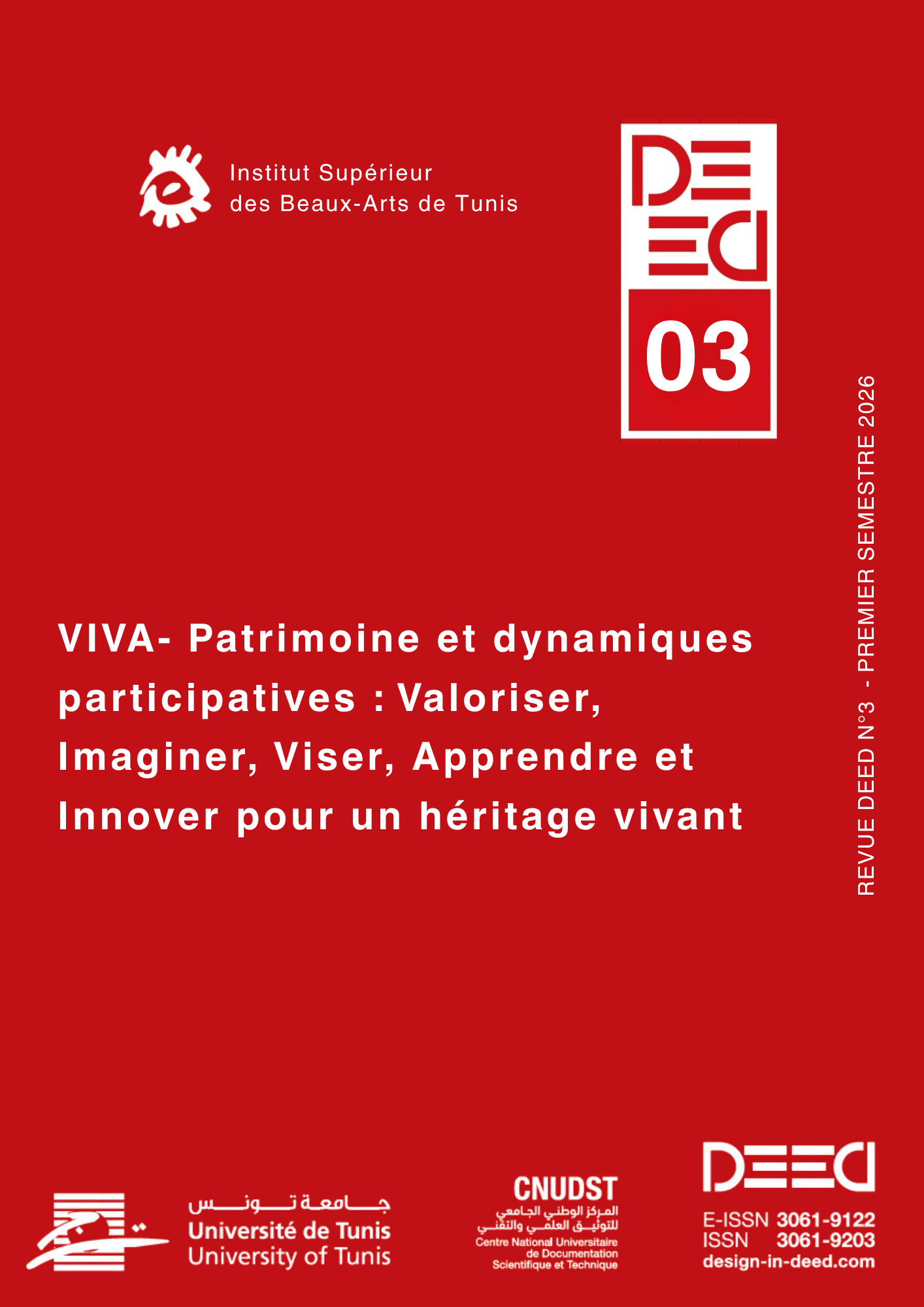
For this new edition, DEED 03 invites dynamic heritage initiatives and proposes to explore how design education can contribute to:
- Enhancing situated, vernacular, and immaterial knowledge;
- Imagining narratives, scenarios, and possible futures;
- Aiming for responsible transformations rooted in local territories;
- Learning with and from communities;
- Innovating through collaborative methods, emerging technologies, and AI.
This theme also addresses two essential issues:
The conditions for preserving traces, both material and memorial, without which no transmission or transition is possible; The (re)valorization of matrilineal heritage, these often fragile or invisible feminine legacies that are fundamental for understanding our cultures and lived worlds.
We invite critical, theoretical, empirical, methodological contributions or those arising from projects, coming from design, architecture, digital humanities, heritage studies, applied AI, and more broadly from all disciplines engaged in the relationships between design, pedagogy, heritage/matrilineage, and participation.
Announcements
Call For Papers, ANTICIPATE-DEED - ISSUE Number 4
ANTICIPATE
Art, Design and Pedagogies of Transitions: From Foresight to Action
“Education is the point at which we decide whether we love the world enough to assume responsibility for it.” Hannah Arendt
More…
Insights on Issue 2: Preface and Editorial Now Available
To Discover: The Preface and Editorial of Issue 2 of DEED "Cultural Becoming, Design, and Creative Strategies"
Continuing with the publication of Issue 2 of the journal DEED – Designing Education, Teaching Design, we are pleased to make available the preface and editorial of this issue "Cultural Becoming, Design, and Creative Strategies."
These texts provide insight into the scientific and editorial orientations of this issue as well as the contemporary challenges of design, culture, and creative strategies.
Preface: https://doi.org/10.71585/deed.i2.69
Editorial: https://doi.org/10.71585/deed.i3.70
More…
Call for papers, VIVA-DEED Issue N°3 -
"Heritage is not what is preserved, but what is transmitted and transformed.”
(Bernard Stiegler, 2010)
More…
Preface
Editorial
Articles
DEED – Designer l'Enseignement, Enseigner le Design is an international peer-reviewed scholarly journal dedicated to fostering reflection, research, and debate on the relationships between design, pedagogy, educational innovation, and higher education.
The journal is particularly concerned with the challenges and opportunities of the design of educational practices and with contemporary transformations in learning and teaching within contexts shaped by social, technological, cultural, and environmental change.
Emerging from the discussions initiated during the international conference “Enseigner le Design, Designer l'Enseignement” organized by the Higher Institute of Fine Arts of Tunis (ISBAT), DEED aims to develop a field of inquiry dedicated to the design, experimentation, and evaluation of teaching and learning environments.
The journal explores how design approaches, methods, and cultures can contribute to rethinking learning environments, pedagogical practices, modes of knowledge transmission, and educational experiences. It also examines how educational contexts, contemporary transitions, and pedagogical innovations shape design practices and influence the ways in which design is taught and transmitted.
By promoting interdisciplinary perspectives, DEED welcomes theoretical, empirical, methodological, and experimental contributions addressing instructional design, design education, project-led research, action research, educational technologies, artificial intelligence, sociotechnical transitions, and emerging forms of learning.
Its objective is to foster new scientific and methodological perspectives capable of supporting the ongoing transformation of education and contributing to the development of its possible futures.